
AI Customer Support Connects Questions, Leads and Knowledge
AI customer support with real business value does not just automatically answer common questions, but connects customer questions, corporate knowledge base, consultation records, lead allocation and sales follow-up, so that every consultation can be accepted and reviewed.
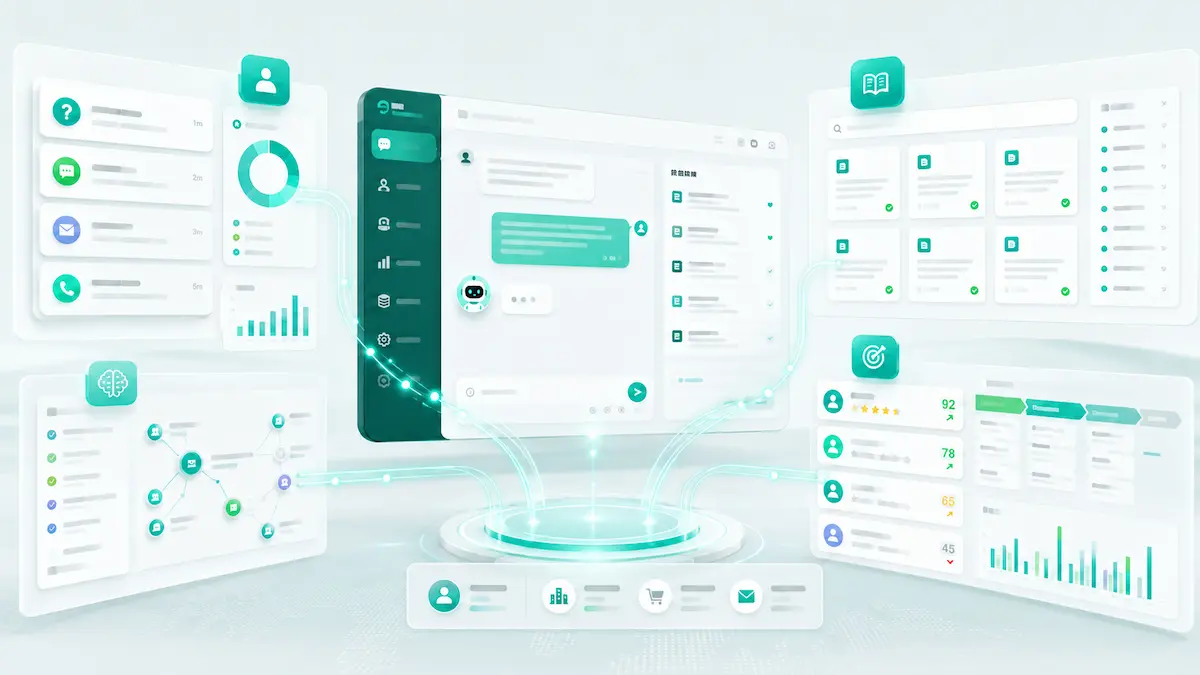
Many companies understand AI customer support as an "automatic reply robot": whatever the customer asks, the system will find an answer from the preset vocabulary. But in real business, customer inquiries is often not just about asking a question, but about expressing needs, comparing plans, judging trust, and testing prices and delivery capabilities. If AI customer support only stops at automatic replies, it will be difficult to truly help companies improve conversions.
Quick take: AI customer support needs to connect four things
Truly effective AI customer support should not only answer questions, but should connect consultation, knowledge calling, lead accumulation and sales follow-up.
- Customer questions: Identify what customers really want to solve, rather than just matching keywords.
- Enterprise knowledge base: Use products, services, cases, quotation rules and FAQ to support stable answers.
- Sales leads: Capture customer needs, contact information, source pages and communication focus.
- Follow up: Assign leads to sales and generate next-step communication recommendations.
1. Why can’t “automatic replies” solve real inquiries?
When customers come to the website, quotation page, mini program or customer service window, they often bring specific business background with them. For example, he may want to know whether a certain service is suitable for his project, whether a certain type of product can be delivered on time, what information is needed for a quotation, or whether the company has similar cases. Simple automated responses often only answer fixed questions and cannot determine which decision-making stage the customer is at.
If the AI customer support is not connected to the enterprise knowledge base, it is easy for it to give general answers; if it does not record customer needs, it cannot form leads; if it does not enter the sales follow-up process, customers may still be lost after asking questions. Therefore, the focus of AI customer support is not "automatic" but "undertaken".
2. Which business objects should AI customer support connect to?
AI customer support is not an isolated chat window, but should become the connection point between the website, mini programs, knowledge base, customer leads and sales follow-up.
3. Enterprise self-test: Is your customer service just a “question and answer entrance”?
If the company already has online customer service, telephone, WeChat or form entry, you can first use the following questions to determine whether it needs to be upgraded to an AI customer support and knowledge-enabled support system.
4. How to build an AI customer support system?
1. Organize the corporate knowledge base first
Whether AI customer support can answer questions well depends on whether the company's knowledge base is clear. The knowledge base is not just FAQ, but also includes products and services, cases, quotation rules, delivery processes, after-sales instructions, sales techniques and industry knowledge. Without a knowledge base, AI customer support can only give general answers.
- Organize frequently asked questions from customers into searchable Q&A content.
- Break down products, services, cases and quotation rules into structured knowledge.
- Prepare standard answer boundaries and manual transfer rules for different business scenarios.
2. Redesign the consultation and acceptance process
AI customer support needs to know when to continue answering, when to guide customers to submit requirements, when to ask for supplementary information, and when to transfer to manual or sales. This process determines whether customer inquiries can change from "asking and leaving" to "entering for follow-up".
- Basic inquiries will be answered immediately by AI customer support, reducing waiting.
- When there are clear needs, guide customers to submit contact information, project information and budget cycle.
- High-intent or complex questions are automatically forwarded to humans, and a complete summary of the conversation is retained.
3. Turn conversations into leads
If AI customer support only answers questions and does not collect leads, companies will still be unable to review the quality of consultations. The system should identify customer needs, contact details, source pages, concerns, project stages, and intent levels from the conversation and synchronize them into the customer lead management or CRM process.
- Record which page the customer came from and what questions they asked.
- Identify whether the customer is involved in quotation, proposal, delivery or procurement needs.
- Generate sales follow-up summaries to reduce information loss between customer service and sales.
4. Use review data to reversely optimize the knowledge base and pages
After AI customer support goes online, companies will continue to see issues that customers really care about. Which questions appear frequently, which answers customers are dissatisfied with, and which pages have many inquiries but low conversions can all be used to help companies optimize website content, FAQs, sales techniques and knowledge bases.
- High-frequency questions are added to the FAQ and article content.
- Wrong or ambiguous answers supplement knowledge boundaries and manual validation rules.
- The high-conversion consulting path is captured into a standard sales follow-up process.
5. How AI Customer Support Shapes SEO and GEO Content
The questions customers ask in AI customer support are often the same questions they ask in search engines and AI Q&A. For example, "Which enterprise is this system suitable for?" "How long will it take to launch?" "Can it be connected to existing business processes?" "How to calculate the quotation?" If these problems only stay at the customer service window, they will not form long-term content assets.
A more reasonable approach is to capture high-frequency problems that arise in AI customer support into FAQs, articles, supplementary instructions on service pages, and knowledge base content. This will not only improve the quality of customer service answers, but also make it easier for search engines and generative AI to understand the company's service capabilities.
6. A relatively safe landing path
Enterprises can build AI customer support systems in the order of "knowledge sorting, customer service access, lead accumulation, sales follow-up, and content optimization".
- Step one: organize the knowledge base. Sort out product services, cases, FAQs, quotation rules and sales techniques.
- Step 2: Access the customer service portal. Access the AI customer support window on the website, service page, mini program and quotation page.
- Step 3: Set up acceptance rules. Make it clear which questions will be answered by AI, which questions will be transferred manually, and which questions will generate sales leads.
- Step 4: Capture lead records. Document customer needs, contact details, source pages, conversation summaries, and intent stages.
- Step 5: Access sales follow-up. Assign responsible persons, set reminders, and generate next-step communication suggestions.
- Step 6: Continue to optimize knowledge and pages. Supplement content based on high-frequency questions, incorrect answers, and conversion results.
7. Frequently Asked Questions
What is the difference between AI customer support and ordinary automatic replies?
Ordinary automatic replies usually only answer fixed questions. AI customer support needs to combine the enterprise knowledge base to understand customer needs, record consultation content, identify sales leads, and push customer questions to the follow-up process.
Why does AI customer support need an enterprise knowledge base?
The enterprise knowledge base determines what AI customer support can answer and whether the answer is accurate. The clearer the product information, service scope, cases, quotation rules, FAQs and sales techniques, the more stable the AI customer service will be able to handle real customer inquiries.
How does AI customer support generate sales leads?
AI customer support can identify customer needs, contact information, project background, budget, delivery date and concerns during the conversation, and accumulate this information into lead records, which can be assigned to sales staff for follow-up.
Which companies are suitable for implementing AI customer support first?
It is suitable for enterprises whose website, service page, quotation page or mini program already has a consultation portal, but the customer service response is not timely, questions are repeated, lead records are incomplete, and sales handovers are easily missed.
How to judge whether AI customer support is effective?
Whether AI customer support truly generates business value can be judged from the consultation response rate, number of effective leads, customer problem classification, timely rate of lead allocation, sales follow-up rate and final conversion results.
8. Conclusion: Connect Inquiries to Business Workflows
AI customer support is not a simple automatic reply, but a connection entrance between customer questions, corporate knowledge base, sales leads and follow-up. It not only answers customer questions, but also determines customer needs, accumulates lead information, prompts sales follow-up, and reversely helps companies optimize content and knowledge bases.
When every consultation can be recorded, understood, assigned, and reviewed, AI customer support can truly transform from a "chat tool" into a part of the company's customer acquisition and conversion system.
Connect AI Support, Knowledge and Sales Follow-Up
YUXINCODE can help companies sort out common customer problems, build corporate knowledge bases, access AI customer support windows, and capture consultation content into sales leads that can be assigned, followed up, and reviewed.