
Connect Content, Keywords, Customer Activity and Sales Follow-Up
The AI Lead Generation System does not simply collect customer lists, nor does it only publish content, but connects content assets, keyword coverage, customer activity, channel operations and sales follow-up, allowing companies to have a clear path from being discovered by customers to advancing leads.
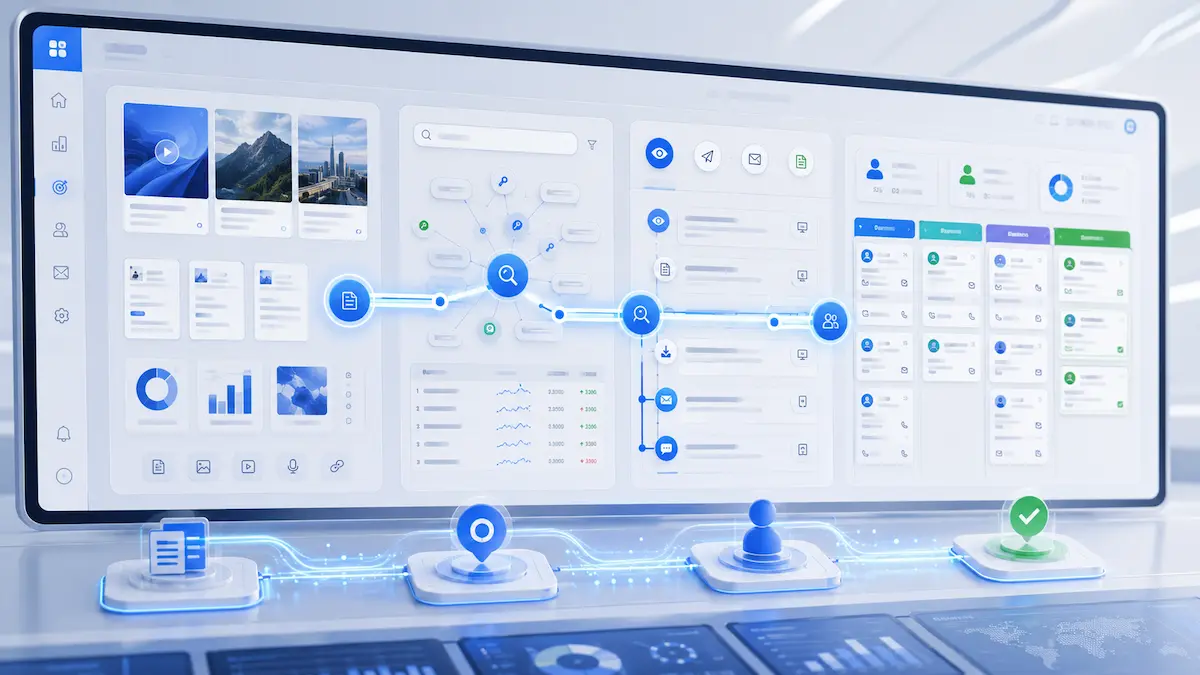
When acquiring customers, many companies handle content, keywords, social media, customer updates and sales follow-up separately: marketers write articles, operations staff look at keywords, sales staff talk to customers themselves, and management sees only the final number of inquiries. The problem with this is that every action is happening, but they don't form a traceable business link.
Quick Take: Connect Five Steps for AI-Led Acquisition
The core value of the AI Lead Generation System is not to "create customers out of thin air" for enterprises, but to connect customer discovery, content construction, keyword coverage, customer dynamic identification and sales follow-up.
- Content: Answer real customers’ questions and make the website, articles, cases and FAQs long-term assets.
- Keywords: Organize content around customer search terms, scenario words, and high-conversion words, rather than just writing about the company.
- Customer news: Continuously monitor target customers, industry topics, competitors and platform changes to discover communication entry points.
- Lead capture: Capture visit, consultation, form, phone, WeChat and quotation needs into the customer lead pool.
- Sales follow-up: Let each lead have the person responsible, status, next action and review data.
1. Why do many customer acquisition actions fail to produce results?
It’s not that the company hasn’t done anything to acquire customers. Many companies will build websites, publish articles, place advertisements, post in Moments, operate WeChat Official Accounts, update cases, and also let sales develop customers. But the problem is that these actions are often scattered among different people, different tools and different channels. In the end, it is difficult to answer three questions: What content brings customers? Which keywords are valuable? Which customer updates warrant sales follow-up?
If the content is not associated with keywords, the article is just a publishing record; if the keywords are not associated with the page, rankings may not necessarily bring inquiries; if customer activity do not enter the sales process, sales can still only rely on personal experience to find topics; if leads have no status and follow-up records, management cannot judge whether customer acquisition is truly effective.
2. What core links should the AI Lead Generation System connect?
Complete AI customer acquisition does not just look at "whether there are leads", but also tracks everything from customer awareness, customer search, customer browsing, customer interaction, customer follow-up to subsequent conversions.
3. Enterprise self-test: Where is the current customer acquisition link broken?
Enterprises can first use the following questions to determine the shortcomings of the current customer acquisition system. If the answer to a certain item is unclear, it means that this link has not been truly systematized.
4. How to build an end-to-end workflow for AI customer acquisition?
1. First turn content into searchable assets
Content is the basis for AI customer acquisition. The customer will not consult because the company writes "We are very professional", but because the page answers his specific questions: whether the service can be provided, how long the cycle is, how to quote, what cases are there, and how to control risks. Enterprises should continue to build content around service pages, case pages, FAQs, industry knowledge bases, and article blogs.
- The service page explains what problems the company can solve and which customer scenarios it is suitable for.
- The case page proves that the company has real project experience and delivery capabilities.
- FAQs and articles answer frequently asked questions in customer searches and AI Q&A.
2. Then use keywords to connect content with customer searches
Keywords are not simply piled on the page, but used to determine how customers will express their needs. For example, customers may search for "AI Lead Generation System", "AI customer lead management", "AI marketing content monitoring", "GEO optimization diagnosis" and "customer activity tracking". Different keywords represent needs at different stages, and the pages should also correspond to different conversion paths.
- Core business words correspond to the system introduction page and service page.
- Question-type keywords correspond to articles, FAQs and knowledge bases.
- Scenario words correspond to solutions, cases, and industry pages.
3. Use customer activity to find a more natural communication entry point
Many B2B sales difficulties lie in "when to contact customers and for what reason." Customer activity tracking can monitor the target customer's website, WeChat Official Account, WeChat Channel, Douyin, Xiaohongshu, Zhihu, Bilibili, e-commerce platform and public news. When customers launch new products, expand business, update recruitment, and adjust product lines, sales have more specific reasons to communicate.
- New product launches may mean the need for proofing, packaging, structural parts, or outsourcing.
- Hiring and business expansion may mean project growth or supply chain changes.
- Social media content and customer reviews can help sales determine what customers are focusing on recently.
4. Integrate leads into the sales follow-up process
Customer acquisition ultimately comes down to lead follow-up. If customer inquiries, forms, phone calls, WeChat, and quotation requests do not enter the unified lead pool, it will be impossible to determine which content is effective, which channels are valuable, and which customers need priority. After the leads are entered, there needs to be allocation, status, reminders, words and review.
- Record the customer source page, keywords, consultation content and contact information.
- Generate suggestions for first contact, demand confirmation, follow-up visits after quotation, etc. based on customer stages.
- Flow closing, churn, and long-term cultivation results back into content and keyword optimization.
5. Why structured content matters for SEO and GEO
SEO focuses on whether search engines can crawl, understand, and rank pages, and GEO focuses on whether generative AI can understand, cite, and recommend corporate content. Whether it is search results or AI Q&A, it is easier for the system to identify pages with a clear structure, clear questions, and complete information.
Therefore, the AI Lead Generation System cannot only generate scattered articles, but must form a network between the contents: the service page explains the business boundaries, the articles explain customer problems, the FAQ handles questions and answers, the cases provide credible support, and the industry knowledge base enhances the density of professional information. This makes it easier for customers, search engines, and AI tools to understand what the company can do, who it is suitable for, and why it is trustworthy.
6. A relatively safe landing path
Enterprises can build an AI Lead Generation System in the order of "content assets, keyword coverage, dynamic monitoring, Lead capture, sales follow-up, and data review".
- Step one: sort out what customers will ask. Identify the issues your customers care about when searching, consulting, and making decisions.
- Step 2: Turn the question into content. Build service pages, case pages, FAQs, articles and knowledge bases.
- Step 3: Map content to keywords. Let each type of keywords have corresponding pages to capture.
- Step 4: Monitor customer and market dynamics. Identify opportunities from target customers, competitors, social media and platform changes.
- Step 5: Hand the lead over to the sales process. Assign responsible persons, set status, generate follow-up suggestions and review results.
- Step 6: Use data to reversely optimize content and channels. Continuously analyze which content brings leads and which keywords are worth continuing to invest in.
7. Frequently Asked Questions
What problems does the AI Lead Generation System mainly solve?
The AI Lead Generation System mainly solves the problems of customer opportunity discovery, continuous content construction, keyword coverage, dynamic customer identification, Lead capture and sales follow-up, allowing enterprises to acquire customers from scattered actions into a sustainable operation process.
Why does the AI Lead Generation System start with content and keywords?
Customers usually first learn about the company through search, AI Q&A, industry content, cases and social media. Content and keywords determine whether customers can find the company, and also determine whether search engines and AI tools can understand the company's service capabilities.
What role does customer activity tracking play in AI customer acquisition?
Customer activity tracking can identify changes in target customers' websites, social media, e-commerce platforms and public information, helping sales to find communication entry points such as new product releases, procurement needs, business expansion and supplier replacement.
What is the difference between AI Lead Generation System and CRM?
CRM is more focused on managing customers who have already entered the enterprise and the sales process. The AI Lead Generation System emphasizes discovering opportunities before customers enter, building content, covering keywords, monitoring market dynamics, and pushing leads to the follow-up process.
How to judge whether the AI Lead Generation System is effective?
You can observe whether indicators such as keyword coverage, content collection, page visits, consultation submissions, customer sources, lead distribution, follow-up timeliness, and transaction conversions continue to improve.
8. Conclusion: The key to AI customer acquisition is to make the actions continuous.
The value of the AI Lead Generation System does not lie in replacing all marketing and sales actions, but in connecting these actions into an end-to-end workflow. Content allows customers to see the company, keywords allow customers to find the company, customer activity allows sales to know when to communicate, the lead system prevents inquiries from being lost, and the follow-up process allows opportunities to continue to advance.
When an enterprise can continuously record content, keywords, dynamics, leads and quote outcomes, it can gradually shift from "acquiring customers based on experience" to "using systems and data to continuously optimize customer acquisition". This is also the role that the AI customer acquisition system should really play.
Connect content, keywords and lead follow-up?
YUXINCODE can help enterprises build a sustainable AI Lead Generation System around website content, SEO/GEO, customer activity tracking, marketing content monitoring and lead development processes.