
Build Reusable Quotation Rules, Parameters and Experience
The AI quotation assistant does not automatically fill in the quotation form, but captures the product parameters, cost rules, quotation logic, manual review and historical transaction feedback that the company relied on manual experience in the past, making the quotation faster, more stable, and more repeatable.
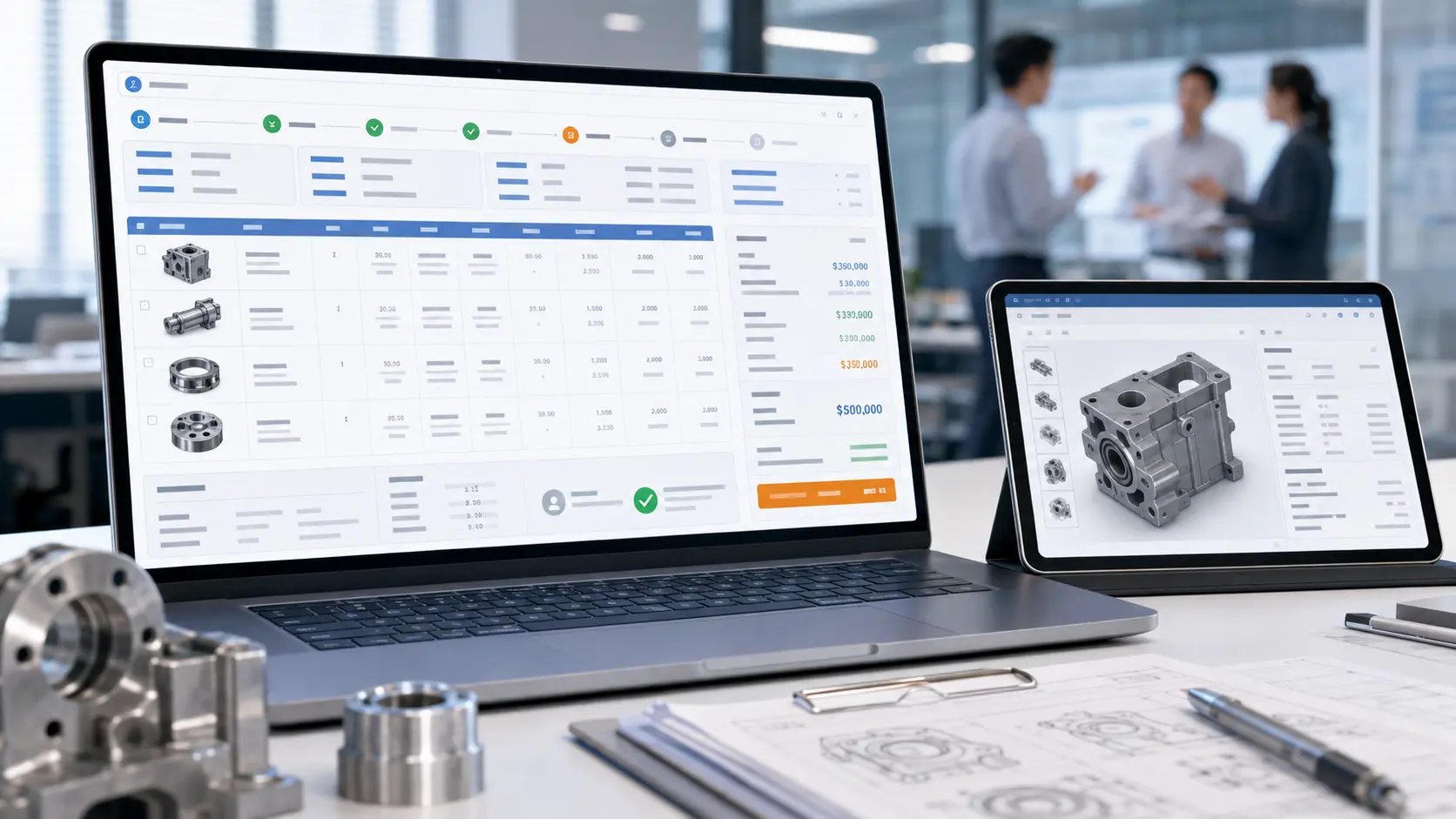
The quotation ability of many enterprises is in the hands of a few experienced sales, engineers or managers. Newcomers don’t know how to estimate, old employees can’t take their experience with them after they leave, different staff’s quotations are inconsistent, and it’s difficult to reuse historical quotations. What the AI quotation assistant wants to solve is not to "quote a random price for others", but to capture the rules, parameters and experience behind the quotation into system capabilities.
Quick take: AI quotation assistant must accumulate five types of abilities
The core of the AI quotation assistant is not to "automate bidding", but to transform the quotation process from personal experience to regularization, parameterization, reviewability and reviewability.
- Product parameters: Standardize the fields that affect the quotation such as material, size, quantity, process, post-processing and delivery time.
- Cost rules: Captured material costs, processing costs, labor costs, outsourcing costs, logistics and packaging and other rules.
- Quotation logic: Turn quantity ladders, starting prices, losses, profit margins and risk factors into executable algorithms.
- Manual review: Complex projects still require professionals to confirm process feasibility, risks and final price.
- Historical experience: Record transactions, churn, customer feedback and profits, and reversely optimize subsequent quotation strategies.
1. Why is it easiest to rely on personal experience for quotations?
The quotation seems to be just a price for the customer, but in fact it contains product parameters, process judgment, material costs, quantity ladders, delivery risks, supply chain capabilities, customer types and profit requirements. Many companies can advance quickly by relying on manual experience in the early stage. However, when the business volume increases, problems such as slow quotation, inconsistent quoting standards, unstable profit margin, and inability to reuse historical experience will appear.
Especially in manufacturing, custom development, service projects and complex delivery scenarios, customer needs are not standardized. Sales need to understand customer requirements, engineering needs to determine feasibility, finance or managers are concerned about profit margins, and historical quotations will affect customer expectations. What the AI quotation assistant has to do is organize this scattered information.
2. Which quotation objects should the AI quotation assistant target?
The AI quotation assistant is not an isolated calculator, but should connect products, costs, rules, personnel review and historical data.
3. Enterprise self-assessment: Is your quotation still based on personal experience?
If the following situations occur frequently, it means that the company needs to integrate quotation rules and historical experience into the system.
4. How to build an AI quotation assistant?
1. Standardize product parameters first
The first step in quoting is not to calculate the price, but to confirm whether the parameters are complete. Different businesses can have different parameter models. For example, the manufacturing industry focuses on materials, size, volume, process, and post-processing, while software services focus on functional modules, number of accounts, interfaces, data volume, and implementation scope.
- Divide the fields that affect price into fillable, verifiable, and reusable data.
- Distinguish between required parameters, optional parameters and risk parameters that require manual confirmation.
- Let sales collect complete customer requirements before submitting a quote.
2. Redeposited costs and quotation rules
The AI quotation assistant needs to break out the rules that companies relied on manual judgment in the past, such as material unit price, processing fee, starting price, quantity discount, expedited delivery, loss coefficient, profit margin and special risks. Rules do not have to be fully automated from the start, but they must first be documented and structured.
- The standard calculation part is handled by the system.
- Parts that are price sensitive or have higher risks are subject to manual review.
- Rule adjustments should retain the version and effective scope to avoid confusion in quoting standards.
3. Set manual review and approval boundaries
AI quotation assistants should not replace all professional judgment. For complex projects, special materials, large amounts, tight delivery deadlines, abnormal profit margins, or quotes with unclear customer requirements, the system should automatically enter the review process and be confirmed by the person in charge of engineering, sales, or management.
- Low-risk standard requirements enable rapid generation of quote proposals.
- Complex requirements require supplementary information, process confirmation or cost confirmation.
- Abnormally low prices, unusually high prices, and low-margin quotes require approval.
4. Use historical quotations to reversely optimize quotation strategies
Completion of an offer is not the end. The system also needs to record whether the customer accepted it, why they lost it, what the final final price was, whether the actual cost deviated, and whether the profit margin was reasonable. The more complete the historical quotation is, the more evidence-based reference the subsequent AI quotation assistant can provide.
- Review the transaction rates of different customer types and quantity ranges.
- Analyze the reasons for quotation loss and customer price feedback.
- Adjust quotation rules based on real profits and delivery results.
5. From the perspective of SEO and GEO, quotation rules can also become content assets
Customers often ask in search and AI Q&A "How to quote", "What are the factors that affect the price", "Why do prices vary greatly for the same project" and "What information needs to be provided". If a company can organize quotation logic, data requirements, common influencing factors and risk descriptions into articles, FAQs and service pages, it can enhance customer understanding and trust.
This kind of content is not only helpful for search engines to understand enterprise services, but also for generative AI to identify the professional boundaries of enterprises. More importantly, it can reduce the sales cost of repeatedly explaining the quotation logic, so that customers understand the basic rules before consulting.
6. A relatively safe landing path
Enterprises can build AI quotation assistants in the order of "parameter standardization, rule capture, quotation calculation, manual review, and historical review".
- Step one: sort out the quotation fields. Clarify what product parameters, project requirements and delivery conditions the customer must submit.
- Step 2: Organize cost rules. Break down materials, processes, labor, outsourcing, logistics, packaging and starting prices into rules.
- Step 3: Configure quotation logic. Form quantity ladders, profit margins, delivery dates, risks and approval boundaries.
- Step 4: Access quotation generation. Convert quotation results into formal communications that customers can understand.
- Step 5: Reserve manual review. Set up professional validation processes for complex, high-risk or high-dollar projects.
- Step 6: Review historical quotes. Use quote outcome, reasons quotes are lost and profit data to continuously optimize quotation strategies.
7. Frequently Asked Questions
What is the difference between AI quotation assistant and ordinary quotation template?
Ordinary quotation templates mainly solve the problem of unifying the format. The AI quotation assistant needs to combine product parameters, process materials, cost rules, quantity ladders, delivery requirements and historical quotation experience to assist in generating more reasonable quotation results.
Why does the AI quotation assistant need product parameters?
Product parameters are the basis for quotation calculations, such as material, size, volume, surface area, process, post-processing, quantity and delivery time, which all affect the cost and quotation. The more standardized the parameters, the easier it is for the quotation to be stably reused.
What role does historical quotation data play in AI quotations?
Historical quotations can help companies review different customers, products, materials, quantities and quote outcomes, identify common quotation ranges, reasons quotes are lost and profit boundaries, and provide reference for subsequent quotations.
Can complex projects still be reviewed manually?
Complex projects still require manual review. The AI quotation assistant is suitable for completing parameter sorting, rule calculation and quotation suggestions first. When encountering projects with complex structures, high risks or large amounts, the manual confirmation process should be entered.
How to judge whether the AI quotation assistant is effective?
Whether it is effective can be judged from indicators such as quotation response time, quote consistency, manual review ratio, quotation conversion rate, profit margin stability and historical quotation reuse rate.
8. Conclusion: Make Quoting Experience Reusable
The AI quotation assistant does not simply automatically generate prices, but helps companies accumulate quotation rules, product parameters, cost logic, manual review and historical experience. It allows quotations to no longer rely solely on the experience of a few people, but gradually forms an executable, checkable, and reviewable process.
When companies can continuously record the basis, results and feedback of each quotation, quotation efficiency, quotation consistency and the quality of business decisions will be improved.
Ready to turn quotation knowledge into system capabilities?
YUXINCODE can help enterprises sort out quotation fields, cost rules, quotation processes, manual review and historical quotation review mechanisms, and build an implementable AI quotation assistant system.