
See Leads, Conversions, Orders and Cash Flow Clearly
The core value of the enterprise data analysis system is to unify the data scattered in the website, sales, quotations, orders and finance, so that management can find out customer quality, conversion efficiency, order risk and cash flow pressure from the operating results.
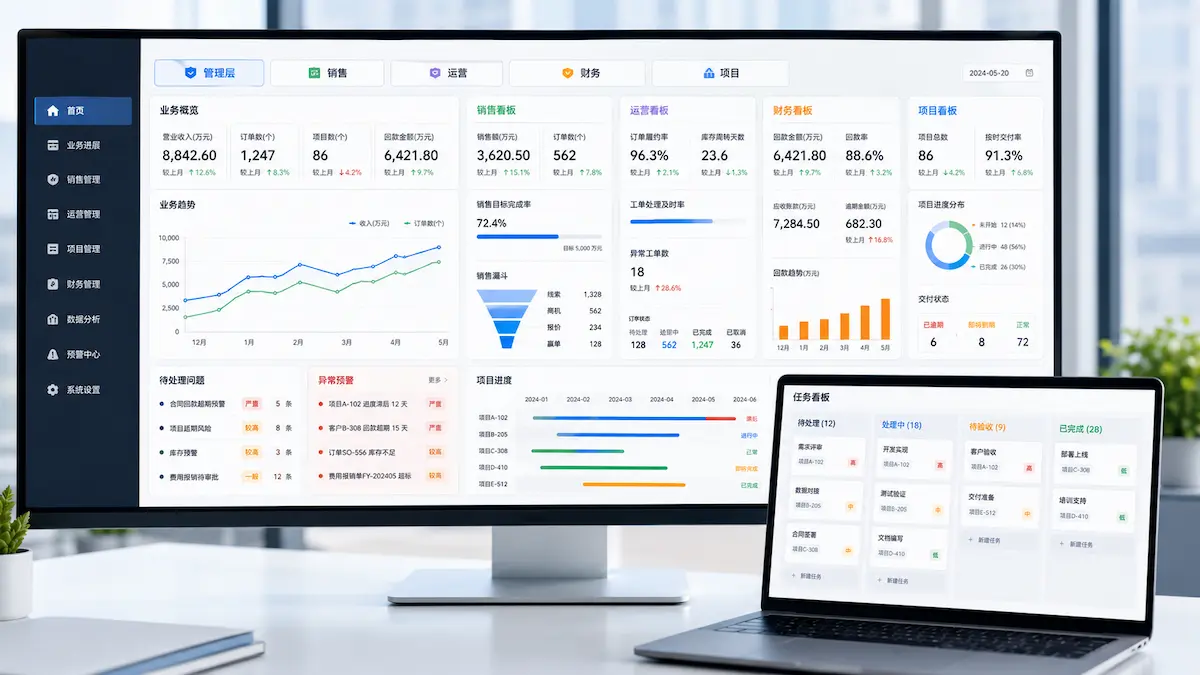
It’s not that many companies don’t have data, but that the data is scattered in different places: the website has access and forms, sales have customer follow-up, quotation records are in the quotation table, project progress is in the order system, and invoicing and payment collection are in the financial table. What management needs to know is not a certain table, but when these data are connected, whether the company's current customer acquisition is effective, whether the conversion is healthy, whether the order is controllable, and whether there is a risk in payment collection.
Quick take: Data analysis system needs to answer business questions
The enterprise data analysis system does not make the charts look better, but puts customer acquisition, conversion, orders and payment collection under the same business perspective. Management needs visibility into where customers come from, which channels bring effective leads, whether sales are followed up in a timely manner, whether quotations are converted into orders, whether orders are delivered smoothly, and whether receivables are collected in a timely manner.
- Customer acquisition: See clearly the source of leads, visiting pages, inquiry entry points and channel quality.
- Conversion: See clearly the reasons for lead follow-up, quotation conversion, transaction conversion and churn.
- Order: See clearly the project amount, delivery schedule, delay risks and abnormal status.
- Refund: See clearly the amount receivable, the amount collected, overdue accounts and cash flow pressure.
1. Why do managers often fail to see clearly the true business status?
In the daily operations of an enterprise, each department will generate data, but these data often only serve this department. The market depends on traffic, sales depends on customers, quotation depends on quotation, delivery depends on order, and finance depends on payment collection. It’s okay to look at each table individually, but once you want to answer questions such as “Why did growth drop this month?” “Which channels really bring orders?” “Which customers occupy funds?”, cross-department data need to be connected in series.
Without a unified data definitions and analysis system, management can only rely on month-end summaries, manual reports and verbal feedback from departments. Lagging data, inconsistent definitions, and unclear responsibilities will lead to slow business decisions.
2. What core indicators should management prioritize?
A data analysis system should not be filled with charts and graphs from the start. For most small and medium-sized enterprises, the efficiency of business judgment can be significantly improved by first clearly understanding the four indicators of customer acquisition, conversion, orders and payment collection.
3. Enterprise self-assessment: Do you need a data analysis system?
If the following situations occur frequently, it means that the company's data has affected management efficiency and a clearer data analysis system needs to be built.
4. How should the data analysis system design the dashboard?
1. Management reviews the business overview
The business overview does not need to show all the details, but should highlight the core trends: this month's revenue, profit, transaction customers, new customers, key customer contributions, repayment amount, unpaid amount, and exception reminders. Management should first review the overall health and then drills down to specific issues.
2. Sales look at customers and conversions
The sales board should focus on the number of leads, effective customers, follow-up status, number of quotes, number of transactions, long-term customer cultivation and pending tasks to help sales know which customers need priority follow-up.
3. Delivery depends on the order and risks
The order board should focus on project stages, delivery dates, delayed projects, abnormal projects, after-sales issues and responsible persons, so that delivery risks can be exposed in advance instead of waiting for customer prompting to deal with them later.
4. Finance looks at receivables and cash flow
The financial dashboard should focus on receivables, received, overdue, invoicing, customer arrears, and supplier payouts to help companies determine capital recovery pressure and payment arrangements.
5. Where does the data of the data analysis system come from?
The data analysis system cannot rely solely on manual reporting. A better way is to automatically summarize data from the company's existing business systems, website forms, customer management, quotation systems, order systems and financial records, and then clean and correlate them through a unified approach.
This means that enterprises need to first clarify fields, states and data relationships. For example, after a customer submits a demand from the website, whether it will enter the customer pool; whether the sales will be followed up; whether a quotation will be generated; whether the quotation will be completed; whether the order will be delivered; and whether the finance department will issue an invoice and receive payment. Only when this link is opened, the Kanban board will not be a static chart, but a real business system.
6. A relatively safe landing path
When enterprises build data analysis systems, they can start with high-value, verifiable indicators to avoid getting stuck in complex data warehouse construction at the beginning.
- Step one: Sort out the business issues that matter most to management, such as whether customer acquisition is effective, whether sales are converted, whether orders are delayed, and whether payment is overdue.
- Step two: Unify the metric definitions and clearly define the fields such as number of customers, number of leads, number of quotes, order amount, and payment amount.
- Step three: Open up core data sources and give priority to customer, sales, quotation, order and financial data.
- Step 4: Construction and operation overview, sales conversion, order delivery and financial payment collection dashboard.
- Step 5: Add abnormal warnings and automatic reports to allow the system to proactively remind the person in charge to deal with the problem.
7. Frequently Asked Questions
Can the analysis system be built first when the data is incomplete?
Yes, but you need to first clarify which data is available and which data is missing. Start with the core indicators and the most reliable data sources, and at the same time gradually complete the data through system construction.
Is the data analysis system only for management?
No. Management reviews the business overview, sales looks at customer conversion, operations looks at channel effects, delivery looks at order risks, and finance looks at the pressure on payment collection. Different roles require different boards.
After the data dashboard is ready, why does it need to be continuously optimized?
Enterprise business will change, and indicator definitions, channels, products, teams, and management priorities will all be adjusted. Data dashboards need to be continuously updated to follow business issues in order to be useful in the long term.
8. Conclusion: What Management needs visibility into is a complete business link
The goal of the enterprise data analysis system is not to display more charts, but to link customer acquisition, conversion, orders and payment collection into a complete business link. Only by knowing where customers come from, why they convert, where the order is stuck, and whether the funds are recovered can management make more timely and well-founded business decisions.
For small and medium-sized enterprises, the data analysis system does not have to be complicated at the beginning, but it must start from real business problems. Only by first clearly understanding the key indicators, and then gradually adding early warnings, automatic reports, and AI-assisted analysis, can enterprise management move from intuition to data-driven management.
Track Acquisition, Conversion, Orders and Payments
YUXINCODE can help enterprises plan and develop data analysis systems such as business overview, sales conversion, order delivery, financial collection, and abnormal warning based on the company's real business data.